Control consequential actions across security agents and automation using trusted enterprise context, shared impact limits, and deterministic policy outside the model.
Built first for security operations and security automation.
One action. Different consequences.
Proposed actionendpoint.isolate
Illustrative policy decisions using trusted resource context
Trusted resource context
Policy decision
Development workstationStandard endpoint
Allow
Domain controllerTier-0 identity infrastructure
Deny
Production serverBusiness-critical workload
Held
Held means approval is required. Permission to act is separate from evidence that it happened.
Illustrative policy, using synthetic resources. This is not live activity.
Agent Action Control Plane
Prompts are instructions. Policies are controls.
A workflow may need to isolate one compromised workstation. Its service account may be able to isolate every endpoint. A prompt asking the agent to avoid critical systems does not narrow that credential.
ExecBound evaluates the action, target and trusted context before a protected action can execute. Bound what AI agents can do, even when their credentials can do more.
Instruction inside the model
“Contain the incident. Don’t disrupt critical systems.”
Controls outside the model
Resolve the target against trusted inventory.
Deny isolation of Tier-0 infrastructure.
Require approval for production resources.
Reserve impact against shared limits.
Example policy on an ExecBound-protected Execute path.
Current action catalog
endpoint.isolate
endpoint.lift_isolation
identity.disable
identity.enable
identity.revoke_sessions
identity.reset_password
Optional learning examples use controlled mocks. Catalog entries do not establish real-provider coverage.
How it works
Decide on the consequence, before the action leaves.
One decision model for MCP, HTTP and integrated execution checkpoints.
Identify the action
Authenticate the caller. Map the request to a canonical action and resource. Unknown consequential actions fail closed.
Resolve, then decide
Read trusted context, apply deterministic policy and reserve impact. Caller claims cannot satisfy required trusted facts. Missing or stale required evidence stops dispatch.
Control and record
Allow, deny or require a named human’s approval. On protected paths, recheck authority before execution and retain the result with its evidence.
Separate agents. Shared impact.
Count affected targets across agents, runs and protocols within the configured principal and tenant limits. Atomic reservations keep simultaneous requests from each spending the same remaining capacity.
Choose the action path
Monitor. Gate. Execute.
Start with visibility, connect an existing executor, or route protected actions through the ExecBound gateway. Each path carries its own evidence and enforcement mode.
Monitor
Understand recorded activity
Bring in observations and authority evidence from connected systems. See the activity and authority evidence ExecBound has for each recorded action path, its enforcement mode, and the gaps that remain unknown.
Visibility without prevention. Observations do not authorize actions, settle provider outcomes or prove that every bypass path is known.
Gate
Keep your existing executor
An existing gateway or workflow asks ExecBound for a decision bound to the exact request, reserves impact, executes with its own connector, and reports the outcome.
The executor keeps its credentials. Enforcement depends on a proven blocking control point. A skippable check remains advisory; an executor’s report is not independent provider proof.
Execute
Use the protected gateway
Agents call ExecBound over MCP or HTTP. ExecBound holds the upstream credentials, applies policy, and dispatches through its controlled execution path.
A protected credential boundary. Enforcement covers the documented routes whose credentials and execution cannot be bypassed by the agent.
Built first for security operations. Designed for every consequential agent.
Control brings policy, trusted context, approvals and shared impact limits to a common decision layer. Gateway provides the MCP and HTTP execution boundary. Integrated checkpoints connect that decision layer to an existing executor.
Start with endpoint containment and identity response across SOAR, agents and automation. The architecture centers on identities, actions, resources and context, so the control plane can extend beyond security operations as new paths are qualified.
app.execbound.ai
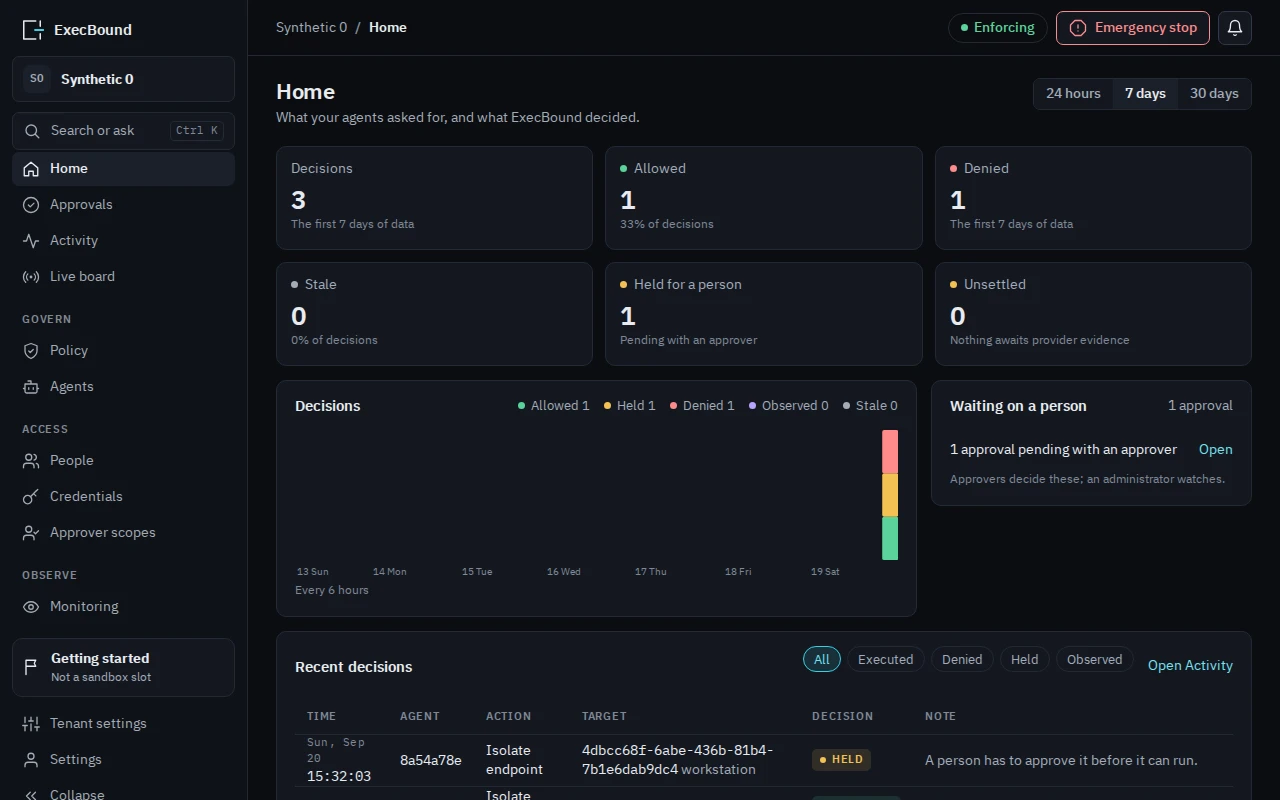
The current console, captured from a seeded tenant with synthetic data.
A decision and an outcome are different records.
Allowed
Policy permits the action. Execution and its result still need evidence.
Denied
The protected action is not dispatched. Its reason is recorded.
Held
Awaiting approval. An approval is single-use, expires, and still requires current authority and context checks.
Replay before changing policy.
Test a candidate policy against retained decision history. Compare decisions using the recorded context without calling a provider or changing live budgets, approvals or execution state. Missing historical evidence stays unresolved.
Provider timeouts may leave an outcome uncertain. ExecBound keeps that uncertainty visible and requires sufficient evidence before a retry or refund.
These scenarios exercise the kernel against controlled mock providers and synthetic data. No real endpoint or identity provider is changed.
A credential the agent cannot reach
The upstream credential stays inside the protected service. The agent has its own gateway identity and no direct provider authority.
One policy, three answers
Allow a development workstation, deny a domain controller, and hold a production resource for an authorized human’s review.
Trusted facts over caller claims
The agent claims context that does not match its target. Authoritative evidence determines the decision; the caller’s claim remains a claim.
A shared ceiling across agents
Split isolation requests across two agents and HTTP and MCP. Each request consumes the same configured tenant capacity; splitting the work does not reset the limit.
Self-approval refused, uncertainty kept
An agent cannot approve its own request. A provider that mutates and then times out leaves an uncertain operation with capacity reserved.
A policy change tested against history
Preview a draft policy against recorded decisions and inspect what changes. Replay calls no provider and writes no live execution state.
Security, with the boundaries visible
Inspect the model. Read the limits.
Enforcement is a property of a tested action path. A connected platform, a successful API call or a signed executor report alone does not prove that an agent cannot bypass the control.
The public documentation records the threat model, architecture and acceptance criteria. The integration register keeps research, fixture tests and bounded platform trials distinct.
We review access requests before sending invitations, subject to available capacity. Your tenant starts with synthetic hosts and identities, open incidents and an active policy pack.
Start a persistent Hosted Community workspace with the current three-agent creation limit. Explore optional synthetic examples, then follow guided setup. Self-hosted Community is uncapped.