Control consequential actions across security agents and automation using trusted enterprise context, shared impact limits, and deterministic policy outside the model.
Built first for security operations and security automation.
Fig. 1 One action. Different consequences.
Proposed actionendpoint.isolate
The decision on endpoint isolation for each illustrative target
Trusted resource context
Policy decision
Development workstationStandard endpoint, critical incident open
Allow
Domain controllerTier-0 identity infrastructure
Deny
Production workstationTrading desk, critical incident open
Held
Production serverA server: the isolation permit covers workstations only
Deny
Workstation, incident closedIts incident was closed after review
Deny
Host the agent calls a workstationThe request claims criticality 1
Deny
Workstation with an expired recordInventory last observed it outside its freshness window
Refused
Host not in trusted inventoryNo resource or alias resolves
Refused
Held means approval is required. Refused means the request failed closed before policy, because the target or its required trusted context could not be established. Permission to act is separate from evidence that it happened.
Fig. 1 · Illustrative: synthetic targets under ExecBound’s SOC demonstration policy. Every allow, deny and held was computed by the product’s Cedar engine when this page was built, and a refusal is the answer resolution gives before policy; your browser only looks it up. This is not live activity.
01Agent Action Control Plane
Prompts are instructions. Policies are controls.
A workflow may need to isolate one compromised workstation. Its service account may be able to isolate every endpoint. A prompt asking the agent to avoid critical systems does not narrow that credential.
ExecBound evaluates the action, target and trusted context before a protected action can execute. Bound what AI agents can do, even when their credentials can do more.
Instruction inside the model
“Contain the incident. Don’t disrupt critical systems.”
Controls outside the model
Resolve the target against trusted inventory.
Deny isolation of Tier-0 infrastructure.
Require approval for production resources.
Reserve impact against shared limits.
Example policy on an ExecBound-protected Execute path.
Current action catalog
endpoint.isolate
endpoint.lift_isolation
identity.disable
identity.enable
identity.revoke_sessions
identity.reset_password
Optional learning examples use controlled mocks. Catalog entries do not establish real-provider coverage.
02How it works
Decide on the consequence, before the action leaves.
One decision model for MCP, HTTP and integrated execution checkpoints.
Identify the action
Authenticate the caller. Map the request to a canonical action and resource. Unknown consequential actions fail closed.
Resolve, then decide
Read trusted context, apply deterministic policy and reserve impact. Caller claims cannot satisfy required trusted facts. Missing or stale required evidence stops dispatch.
Control and record
Allow, deny or require a named human’s approval. On protected paths, recheck authority before execution and retain the result with its evidence.
Separate agents. Shared impact.
Count affected targets across agents, runs and protocols within the configured principal and tenant limits. Atomic reservations keep simultaneous requests from each spending the same remaining capacity.
Fig. 2 Two agents, one shared ceiling.
Both agents isolate hosts under the SOC demonstration rules. Each may isolate 10 hosts an hour on its own; after that a person must approve. The workspace as a whole may isolate 20 in any 15 minutes; after that every request is denied.
Agent A over HTTP
0 of 10 autonomous isolations used
Agent B over MCP
0 of 10 autonomous isolations used
0 of 20 used
Decisions, newest first
No requests yet.
Agent A isolates ten hosts over HTTP. Each is allowed and reserves one unit: 10 of 20 used.
Agent A’s eleventh request is held. It has used its ten autonomous isolations this hour, so a person must approve, and a held request reserves nothing.
Agent B isolates ten hosts over MCP. Its own allowance is untouched, but every unit counts against the same workspace ceiling: 20 of 20 used.
Every further request is denied, from either agent, over either protocol. An approval does not waive a hard ceiling, and splitting the work across agents does not reset it.
Fig. 2 · Illustrative: the SOC demonstration pack’s two isolation limits, simulated in your browser with no request to anything. ExecBound itself counts them under one lock per workspace, so simultaneous requests cannot each spend the last unit.
03Choose the action path
Monitor. Gate. Execute.
Start with visibility, connect an existing executor, or route protected actions through the ExecBound gateway. Each path carries its own evidence and enforcement mode.
Fig. 3 Where the decision sits, and who holds the credential.
Monitor
Provider credential
Stays with your executor or platform.
Decision
None. ExecBound records activity and authority evidence, with the gaps that remain unknown.
Dispatch
Your executor.
Prevents an action
No. Visibility without prevention.
Gate
Provider credential
Stays with your executor.
Decision
ExecBound, bound to the exact request, with impact reserved.
Dispatch
Your executor, which then reports the outcome.
Prevents an action
Only where the check is a proven blocking control point. A skippable check is advisory.
Execute
Provider credential
Held by ExecBound’s gateway. The agent never has it.
Decision
ExecBound.
Dispatch
ExecBound’s gateway, through its own connector to the provider. The agent reaches the gateway over MCP or HTTP.
Prevents an action
Yes, on the documented routes whose credentials and execution the agent cannot bypass.
Fig. 3 · Each path carries its own evidence and enforcement mode; the rows below describe each one in full.
Monitor
Understand recorded activity
Bring in observations and authority evidence from connected systems. See the activity and authority evidence ExecBound has for each recorded action path, its enforcement mode, and the gaps that remain unknown.
Visibility without prevention. Observations do not authorize actions, settle provider outcomes or prove that every bypass path is known.
Gate
Keep your existing executor
An existing gateway or workflow asks ExecBound for a decision bound to the exact request, reserves impact, executes with its own connector, and reports the outcome.
The executor keeps its credentials. Enforcement depends on a proven blocking control point. A skippable check remains advisory; an executor’s report is not independent provider proof.
Execute
Use the protected gateway
Agents call ExecBound over MCP or HTTP. ExecBound holds the upstream credentials, applies policy, and dispatches through its controlled execution path.
A protected credential boundary. Enforcement covers the documented routes whose credentials and execution cannot be bypassed by the agent.
Built first for security operations. Designed for every consequential agent.
Control brings policy, trusted context, approvals and shared impact limits to a common decision layer. Gateway provides the MCP and HTTP execution boundary. Integrated checkpoints connect that decision layer to an existing executor.
Start with endpoint containment and identity response across SOAR, agents and automation. The architecture centers on identities, actions, resources and context, so the control plane can extend beyond security operations as new paths are qualified.
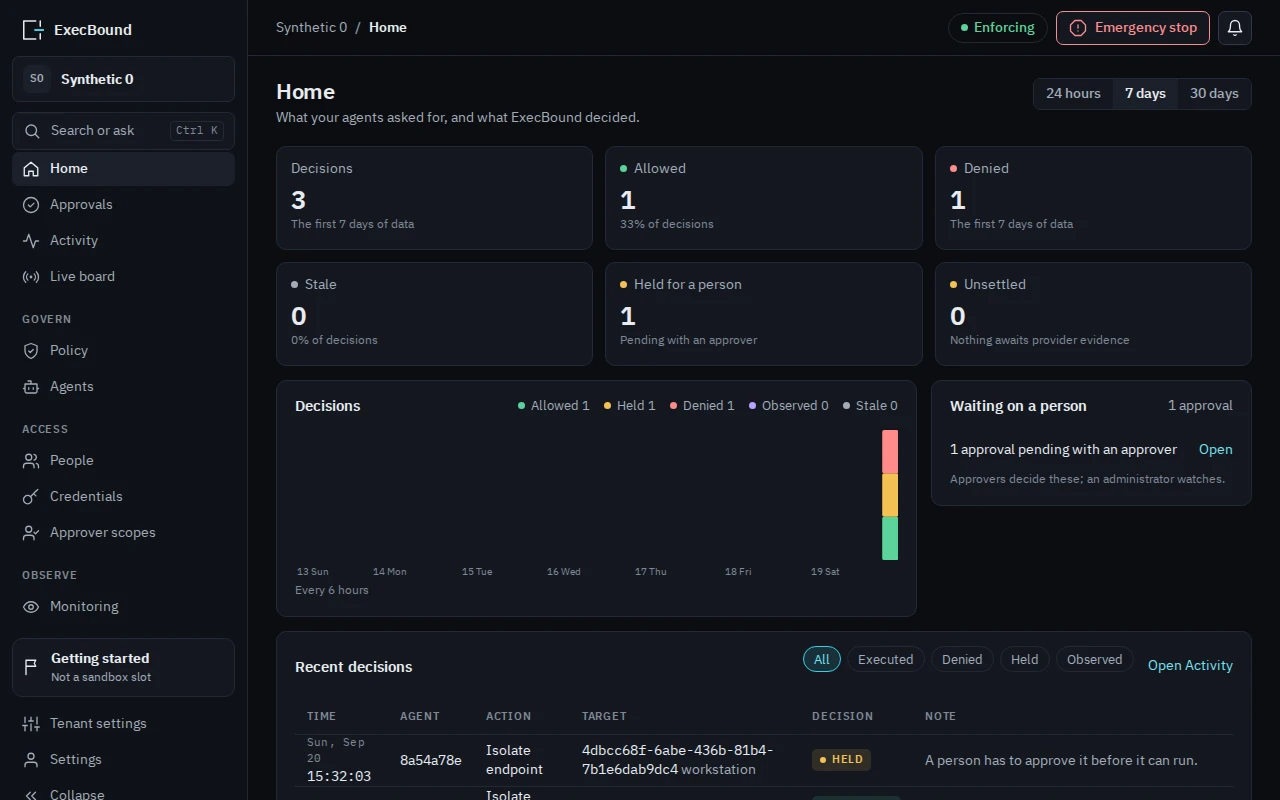
app.execbound.ai
The current console, captured from a seeded tenant with synthetic data.
A decision and an outcome are different records.
Allowed
Policy permits the action. Execution and its result still need evidence.
Denied
The protected action is not dispatched. Its reason is recorded.
Held
Awaiting approval. An approval is single-use, expires, and still requires current authority and context checks.
Replay before changing policy.
Test a candidate policy against retained decision history. Compare decisions using the recorded context without calling a provider or changing live budgets, approvals or execution state. Missing historical evidence stays unresolved.
Provider timeouts may leave an outcome uncertain. ExecBound keeps that uncertainty visible and requires sufficient evidence before a retry or refund.
Fig. 4 One held request, from the hold to its outcome.
The agent asks; policy holds it
The agent asks to isolate ws-trade-0031, a production workstation. A permit matches and the approval set asks for a named person’s review, so nothing is dispatched. A pending approval reserves no impact.
The agent tries to approve itself
The agent calls the approval route for its own request. An agent credential cannot approve, deny or change configuration, so the attempt is rejected and audited.
A named person approves
An analyst with approval scope for this target approves. The approval is for this agent, action, target and plan only. Its expiry was fixed when the request was held: when the plan’s trusted context stops being valid, or earlier if the workspace sets an approval deadline that comes first.
The agent retries and it runs once
Authority and context are checked again, the approval is consumed by one execution claim, and the isolation is dispatched once. It charges one unit to the workspace total and none to the agent’s autonomous allowance.
The same request again
A retry with the same idempotency key returns the result it already has: no second mutation and no second unit. The same action sent under a new key is a new request, decided and counted again.
If the facts had changed first
Had the target’s trusted facts changed before the retry, re-attestation would find a different binding. The approval would be stale and the request would end as STALE_AUTHORIZATION; to try again, the agent sends a new request, which is decided on the facts as they are then.
If the provider timed out
Suppose the provider isolated the host and then timed out. ExecBound records the outcome as uncertain: the impact stays charged, nothing is resent, and the outcome stays uncertain until evidence settles what happened.
Fig. 4 · Illustrative: one request’s lifecycle under the SOC demonstration pack, with synthetic names. Permission to act and evidence that it happened are separate records.
Fig. 5 Replay a policy change against recorded decisions.
Deny isolating production endpoints instead of holding them
Recorded decisions replayed under: Deny isolating production endpoints instead of holding them
Recorded request
Recorded
Replayed
endpoint.isolate on ws-dev-0142Development workstation
Allow
Allow
endpoint.isolate on ws-trade-0031Production workstation
Held
Denychanges
endpoint.isolate on dc-01Domain controller
Deny
Deny
identity.disable on j.ortizStandard user, critical incident
Allow
Allow
identity.disable on svc-paymentsProduction service account
Held
Unresolvedit would need a person's approval, which nobody recorded
identity.reset_password on m.chenStandard user, high-severity incidentrequire_change_at_next_sign_in: true
Allow
Allow
identity.reset_password on j.ortizStandard user, critical incidentrequire_change_at_next_sign_in: false
Held
Unresolvedit would need a person's approval, which nobody recorded
endpoint.isolate on ws-old-0007Workstation, recorded before context capture
Allow
Unresolvedits context was never captured
1 decision certainly changes, 4 stay the same, and 3 are unresolved: Replay will not assume an approval nobody recorded, an action nobody observed, or context nobody captured. It called no provider and changed no live budget, approval or execution state.
Never disable a production identity, rather than holding it for review
Recorded decisions replayed under: Never disable a production identity, rather than holding it for review
Recorded request
Recorded
Replayed
endpoint.isolate on ws-dev-0142Development workstation
Allow
Allow
endpoint.isolate on ws-trade-0031Production workstation
Held
Unresolvedit would need a person's approval, which nobody recorded
endpoint.isolate on dc-01Domain controller
Deny
Deny
identity.disable on j.ortizStandard user, critical incident
Allow
Allow
identity.disable on svc-paymentsProduction service account
Held
Denychanges
identity.reset_password on m.chenStandard user, high-severity incidentrequire_change_at_next_sign_in: true
Allow
Allow
identity.reset_password on j.ortizStandard user, critical incidentrequire_change_at_next_sign_in: false
Held
Unresolvedit would need a person's approval, which nobody recorded
endpoint.isolate on ws-old-0007Workstation, recorded before context capture
Allow
Unresolvedits context was never captured
1 decision certainly changes, 4 stay the same, and 3 are unresolved: Replay will not assume an approval nobody recorded, an action nobody observed, or context nobody captured. It called no provider and changed no live budget, approval or execution state.
Recorded decisions replayed under: Reset passwords only under a critical incident
Recorded request
Recorded
Replayed
endpoint.isolate on ws-dev-0142Development workstation
Allow
Allow
endpoint.isolate on ws-trade-0031Production workstation
Held
Unresolvedit would need a person's approval, which nobody recorded
endpoint.isolate on dc-01Domain controller
Deny
Deny
identity.disable on j.ortizStandard user, critical incident
Allow
Allow
identity.disable on svc-paymentsProduction service account
Held
Unresolvedit would need a person's approval, which nobody recorded
identity.reset_password on m.chenStandard user, high-severity incidentrequire_change_at_next_sign_in: true
Allow
Denychanges
identity.reset_password on j.ortizStandard user, critical incidentrequire_change_at_next_sign_in: false
Held
Unresolvedit would need a person's approval, which nobody recorded
endpoint.isolate on ws-old-0007Workstation, recorded before context capture
Allow
Unresolvedits context was never captured
1 decision certainly changes, 3 stay the same, and 4 are unresolved: Replay will not assume an approval nobody recorded, an action nobody observed, or context nobody captured. It called no provider and changed no live budget, approval or execution state.
Fig. 5 · Illustrative: eight synthetic recorded requests. Both columns were decided by the product’s Cedar engine when this page was built, under the SOC demonstration pack and under each change.
05Explore the six scenarios
See where an agent’s authority ends.
These scenarios exercise the kernel against controlled mock providers and synthetic data. No real endpoint or identity provider is changed.
A credential the agent cannot reach
The upstream credential stays inside the protected service. The agent has its own gateway identity and no direct provider authority.
Split isolation requests across two agents and HTTP and MCP. Each request consumes the same configured tenant capacity; splitting the work does not reset the limit.
Enforcement is a property of a tested action path. A connected platform, a successful API call or a signed executor report alone does not prove that an agent cannot bypass the control.
The public documentation records the threat model, architecture and acceptance criteria. The integration register keeps research, fixture tests and bounded platform trials distinct.
Sign up with your email or a supported sign-in provider, then choose a workspace name. Your workspace starts empty, ready for guided setup and optional synthetic examples. New workspaces are subject to available capacity.
Start a persistent Hosted Community workspace with the current three-agent creation limit. Explore optional synthetic examples, then follow guided setup. Self-hosted Community is uncapped.